Bed Bath & Beyond User Interface

Recently I shopped off the Bed Bath & Beyond website. It was a pretty good experience. Up until the end I was going to give them a hearty thumbs up, but then they blew it.

Good: Website want to get your information. It’s worth real money to them. But they don’t want you to drop out of the purchase because you are so annoyed at their attempts to get your information. BB&B did it just right. Very early on there was the usual screen to create an account to purchase the item. But they had a prominent choice to not create an account. They stated very clearly that you did not have to have an account to shop, and that you would have another chance at the end to create one if you wanted.

They held to their word. Telling the consumer up front builds confidence in the process. Being truthful about the process build confidence that BB&B can be trusted to keep your information private. BB&B can use their easy purchase funnel as a way to convince consumers that are good folks. This experience left me with a rare good taste in my mouth, that of a website that put the consumer first.

Bad: And then they blew it. It came time to do the money. As with most sites, there were a few screens worth. Gift wrapping, did you forget anything, any gift certificates, enter your credit card information, etc. The screen were you click to actually pay the money showed the amount, but didn’t break out the detail. Specifically, they had added in the tax but hadn’t informed you that they had done that and hadn’t displayed the tax amount for you to see. Suddenly the cost seemed to have gone up $15. Coincidentally, my tax was about the same amount as shipping & handling. The screen about shipping had merely said what is was going to do, didn’t say it was doing it, so it looked like they had double-charged me for shipping. I had to call customer support to understand the final bill, which rather defeats the point of doing it all through the web.

You should never show the final cost, or any of the steps along the way, without displaying all the detail that builds up to it.

Links o’ Interest

It’s a short list, but I wanted to get the political ones in here before they become even more obsolete!

Jon Stewart and Steven Colbert on the Sarah Palin pick

McCains VP Short List

Conservative commentators on MSNBC discuss Sarah Palin after the cameras go off

The new Google browser Chrome (in comic book form)

The Abraham Simpson guide to being miserable

What are you going to die from? New charts from the NCI.

Police caught on film.

I doubt this, and yet I’m fascinated. Musical tastes correlated with personality traits.

Cool drawings from Russia. No idea what they mean.

One of a Kind Recording

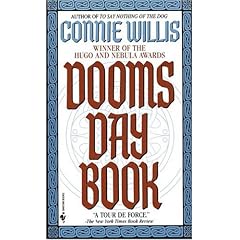
How Not to Write a Book: Connie Willis’ “DOOMSDAY BOOK”

three

On the advice of my brother, I bought this paperback. He knows that I often wonder how long I could survive if I magically time-travelled to the medieval days. Could I teach the medievals some basic science that would vastly improve their lives before they burnt me at the stake for being a godless heretic? Could I convince a king to turn his energies to making sure his subjects were literate, rather than waging war on his neighbors, or would he have me executed for spreading the dangerous idea that monarchs are answerable to their subjects?

The book is 578 pages long. It took 6 years to write. The front cover quotes the NY Times saying it’s a “tour de force”. It won the Hugo and Nebula awards in 1992, which would make you think it’s a great book. What a fool you’d be to think that! It stank worse than a 7th grader’s gym shorts.

The book is basically the story of a grad student historian in the year 2050, who goes back in time to study medieval life in 1320. But as soon as she goes through the “net” to the past, the net operator suddenly collapses with a highly infectious disease. They’re supposed to re-open the net in 2 weeks to bring the historian back – but with the university quarantined and no other net operators available, what are they going to do? She’ll be trapped in the past forever! Meanwhile, the historian arrives in the past with a similar debilitating infection. Now she can’t remember where the drop point was, so how’s she going to get back to it for the rendezvous in 2 weeks?

OK, so far, that’s a decent plot. But here’s where it all goes wrong.

– The net operator collapses on page 24.
– The historian is clearly ill on page 80.

AND THEN NOTHING ELSE HAPPENS FOR 310 PAGES!!!!

Folks, I’m not exaggerating, it’s 310 pages of the university staff going back-and-forth to hospitals trying to figure out what the disease is while their phones keep malfunctioning, intercut with the historian girl spending all her time in bed trying to figure out how to ask someone where she was found without blowing her cover. Holy cow. What’s your reward for slogging through these 310 pages of boredom? NOTHING. The plot doesn’t move forward. The characters don’t develop. All we get is boring minutae.

Here’s the rules you broke, Connie Willis. Pay attention.

    1. Your protagonist must be active. They drive the story. Having the historian laid up in bed for 200 pages doesn’t make them active!

    2. Have meaningful conflict in your book! “I forgot where the drop is” carries you for a chapter or two –
    not for 310 pages. Especially when your audience suspects that your historian might not be so bummed about spending her whole life in the time period she’s obsessed with.

    3. Write characters we care about. I don’t care about the professor because he is a 1-dimensional character. So is the historian… and the doctor… and the medieval people… and everyone else around them! They are cardboard people. So I don’t really care if they get what they want in the story.

    4. Don’t tell me how to feel by having the characters think it. If someone says something dumb to the professor, Willis invariably writes “how stupid, he thought.” Really? I know it was stupid! You don’t need to have your character think it for me to know it. Give me some credit, lady!

FINALLY, around page 367, we finally confirm what the professor has been worried about this whole time (something the audience has been praying for…) The historian didn’t get to the right year. In fact, she’s 20 years late – right when the Black Plague was roaring across Europe. Holy cow! She’s in the middle of the plague with no medicine and people are gonna start dropping like flies – that’s cool! But really, you’re gonna make me wait 310 pages for that? At page 367, I DON’T CARE BECAUSE I GOT BORED IN THE MIDDLE 290 PAGES!!!! I WANT THEM ALL TO DIE SO THIS BOOK WILL END!

Which leads us to rule 5, which is very similar to rule 2:

    5. Have meaningful AND CONTINUAL conflict in your story! Don’t introduce your little conflict (“I don’t know where the drop site is”) on page 80 and think you’re covered for the rest of the book. Your real punch-in-the-gut conflict didn’t show up until page 367 – “I’m surrounded by people with the plague and we have no medicine!” That should have happened a lot sooner – maybe around page 150? And in between these 2 mini-revelations, each scene needs to have some real tension in it. I can only read about how hard it is for little Ms. Historian to talk without coughing a few times before I lose interest. Or how Mr. Professor keeps trying to dodge one student’s stereotypical protective mother. And you played these games for… how many pages?

This book should have topped out at around 250-300 pages. Those would be pages of regular-size type, thank you, not the itty-bitty type your bloated tome currently uses.

In very un-Goldman-like fashion, I actually STOPPED READING THIS BOOK. It’s true. There’s very few books I have started and not finished, so it takes a lot to get on this list. You made it, DOOMSDAY BOOK.

Please allow me to suggest a good tool to help you with your next work, Connie Willis. Study it hard if you want a 2nd chance from me.

one

PS – actually, I’m lying. There’s nothing Connie can do to get a 2nd chance from me. Even if she memorizes STORY cover-to-cover.

Fantasy Football

I got dragged into fantasy football. I don’t really know what I’m doing, but I think I have a decent team. What do y’all think? (if you’re in the league, keep yer yap shut!)

Player
Brees, Drew QB NO
Rivers, Philip QB SD
Gore, Frank RB SF
Turner, Michael RB ATL
Driver, Donald WR GB
Jennings, Greg WR GB
Welker, Wes WR NE
Olsen, Greg TE CHI
Bulger, Marc QB STL
Ryan, Matt QB ATL
Rhodes, Dominic RB IND
Taylor, Fred RB JAC
Gage, Justin WR TEN
Miller, Zach TE OAK

The State of the Election (538.com)

According to the national polls this has been a close race, only slightly in Obama’s favor. You should be wondering how much the national poll matters. What does the situation look like if you go to each state and see where it’s electoral votes are polling and add it all up?

Ladies and Gentlemen, one of the best election sites out there, www.fivethirtyeight.com. You can look that up and play with all kinds of different possibilities to your hearts content. A dream tool for the amateur politnik.

Oh, by the way? Current projections are Obama 310, McCain 227. The race isn’t nearly as close as you think.

Sarah Palin: What do you Think?

What do y’all think?

I guess my overall take is that it reflects very poorly on McCain. McCain made a horrible pick, and made it without thinking about it or caring about the consequences. This is not a good sign for someone who’s campaign is based on judgment.

Another blogger used this analogy. Both Obama and McCain gambled. Obama played poker. He figured out his odds, weighed the circumstances, and made a move. It might not work, but it’s the best play he can make. McCain played craps, he just rolled the dice and hoped things would work out. Which seems like a better character trait?

Poker Update

I played an error-free game.

That feels so good to say. I’ll say it again, because I’ve never been able to say it before. I played an error-free game. I can’t think of one play that was a mistake.

In the first two hours, I only showed my cards twice. Every other time I folded, or bet big enough to push other people off the hand. That was the big difference. Instead of value-betting non-premium hands I was putting in large bets and getting other people out of the way so I never had to see if my non-premium hands (low and middle pairs, K-J suited, etc.) would hold up. The only two times I showed my hand were both chops with the same person. So two hours in, no one had seen me lose.

When we down to five people, I had a bad luck run. There three coin flip hands in a row (2 overcards vs. a pair) and I lost all three. That’s unfortunate. I was right to be in the hand each time though. I fought back. With three players, I checked the option with 9-3. The flop was K-9-5. With middle pair I made a good-sized bet. He put me all in. It wasn’t much of a decision, a fold would have crippled me and I was getting 3-1 on my money. He had 9-6, his hand held up and I finished in 3rd.

Never been so pleased with my own performance to finish in third. This was my best poker playing since I started blogging it.

Running Total: $116 (three winning weeks in a row…)

McCain votes with Bush 90% of the time, so what?

Is that 90% number true? Is it more than you would expect – after all, many laws are uncontroversial. I hate numbers without context. Here’s some context.

The claim is true. According to Congressional Quarterly’s Voting Studies, in 2007 McCain voted in line with the president’s position 95 percent of the time – the highest percentage rate for McCain since Bush took office – and voted in line with his party 90 percent of the time. However [Why did they feel the need to put “However” in here? It doesn’t rebut anything. Can’t anyone just present facts?], McCain’s support of President Bush’s position has been as low as 77 percent (in 2005), and his support for his party’s position has been as low as 67 percent (2001).

In contrast,

When doing so, they may wish to consider that Obama’s votes were in line with the president’s position 40 percent of the time in 2007. That shouldn’t be terribly surprising. Even the Senate’s Democratic leader, Harry Reid of Nevada, voted with Bush 39 percent of the time last year, according to the way Congressional Quarterly rates the votes.

That’s an enormous difference. I thought it would be an empty soundbite that dissappeared under scrutiny. It didn’t.

The Final Days

[Bush] can flash anger over what he considers unfounded criticism or at something on his schedule he does not like, but he does not wrestle with his inner demons, at least not out loud. “He doesn’t second-guess himself,” Jim Francis, a longtime friend from Texas, told me. “I second-guess myself all the time — ‘Maybe I shouldn’t have done this or that.’ He just doesn’t have that in him. I have never seen him do that….”

That is not a good thing.

The New York Times on Obama’s Economics (sorta)

The New York Times today has two opposing articles with views on what we can expect economically from Obama.

Is History Siding With Obama’s Economic Plan?

This article is based around two astounding facts comparing years under Democratic and Republican presidents. One is that the economy grows faster under Democrats. Surprisingly faster.

Data for the whole period from 1948 to 2007, during which Republicans occupied the White House for 34 years and Democrats for 26, show average annual growth of real gross national product of 1.64 percent per capita under Republican presidents versus 2.78 percent under Democrats.

That 1.14-point difference, if maintained for eight years, would yield 9.33 percent more income per person, which is a lot more than almost anyone can expect from a tax cut.

This is a fascinating fact. The biggest problem is that it doesn’t seem to make any sense. The president doesn’t have many ways to impact the economy. Why would this large difference exist? And yet it does.

Two is that income inequality grows under Republican regimes and lessens under Democratic ones. This seems fairly straightforward. Democrats tax the rich and raise the minimum rage, the Republicans do the opposite. Are the two connected? I believe so, but this is not established at all, and there is no reason to think that if the effect exists it would be immediate.

…if history is a guide, an Obama victory in November would lead to faster economic growth with less inequality, while a McCain victory would lead to slower economic growth with more inequality. Which part of the Obama menu don’t you like?

Because the first point (higher growth under Democrats) doesn’t have any mechanism behind it, you can’t assume it would hold true with an Obama presidency. In fact, it completely ignores Obama. It simply says that because Obama is a Democrat we will see the results we historically have seen with Democrats. This is tempting and suggestive, but in the end and unfounded conclusion. However, the second point (about income inequality) is a fair assumption to make, so on balance it does suggest that Obama will be better for the economy.

Obama’s Questionable Stimulus Plan

I lose respect for Ben Stein with every article of his I read.

But I am a bit worried that his knowledge of economics may not be as extensive as his legal background.

Ben Stein is an ex-law professor with no formal economic background. Glass houses and rocks, ya know? The article is a good explanation of why stimulus checks are a bad idea, economically speaking. After all they are simply borrowing from the future to try and goose todays economy. The net impact is to drive us deeper in debt. I fully agree.

But. Ben Stein is against Obama because Obama is borrowing against the future. That is the same thing as increasing the deficit. If you look at the announced spending plans of the candidates, McCain is borrowing much more. Something like $500 Billion to $350 Billion. (I am unable to find great cites, but this is universally regarded as true. Here’s a weak one. Here’s one that projects $5 Trillion to $3.5 Trillion over the next decade.)

In other words, Ben Stein is an idiot. If you don’t like deficit spending, you should vote for Obama, his bad stimulus plan ($50 Billion) is overwhelmed by his better deficit spending plan.